
Hair colour theory can feel like a lot to remember when you are first learning. Between the colour wheel, warm and cool tones, underlying pigment and neutralisation, it is easy to lose sight of the simple ideas underneath it all.
The good news is that colour theory becomes much easier once you organise it into a few repeatable rules. This beginner-friendly guide explains the foundations clearly so you can build confidence without trying to memorise everything at once.
Start with the three primary colours
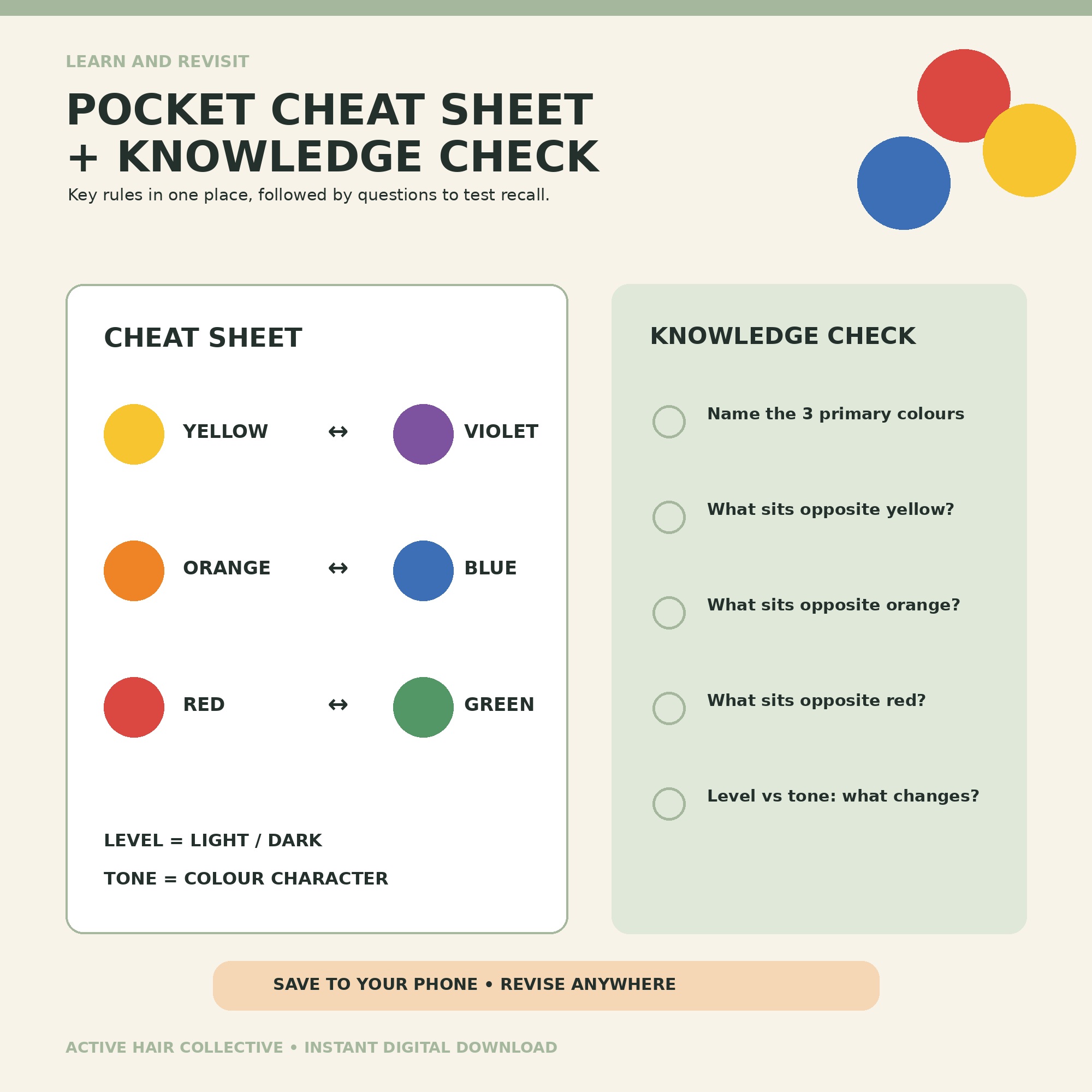
Red, yellow and blue are the primary colours. They are the starting point for the rest of the traditional colour wheel. Mixing two primary colours creates a secondary colour: red plus yellow makes orange, yellow plus blue makes green, and blue plus red makes violet.
For hairdressers, the colour wheel is more than a classroom exercise. It helps you identify what you can see in the hair and understand which colour sits opposite it.
Understand warm and cool tones
Red, orange and yellow are commonly described as warm. Blue, green and violet are cool. Warmth is not automatically a problem: sometimes it needs to be softened, and sometimes it is exactly what the finished result needs.
The important step is to diagnose before choosing a colour direction. Ask what tone is visible, what result is wanted and whether you need to neutralise or enhance.
Use opposites to neutralise
Opposite colours on the wheel help neutralise one another: yellow and violet, orange and blue, and red and green. This is the golden rule behind many colour-correction decisions, but it still needs to be used alongside the hair’s level, condition, history and the manufacturer’s instructions.
Keep level and tone separate
Level describes how light or dark the hair is. Tone describes the colour character you can see. Mixing up the two can make colour selection much harder, so train yourself to assess them separately.



A pocket reference for revision
Active Hair Collective’s Pocket Colour Guide brings these foundations together in a 22-page, mobile-first PDF. It covers the colour wheel, neutralisation, level versus tone, underlying warmth, practical examples, a cheat sheet and a knowledge check.
Educational note: This article and the Pocket Colour Guide support learning and revision. They do not replace professional hair-colour training, strand testing, allergy alert testing, salon procedures or manufacturer instructions.