
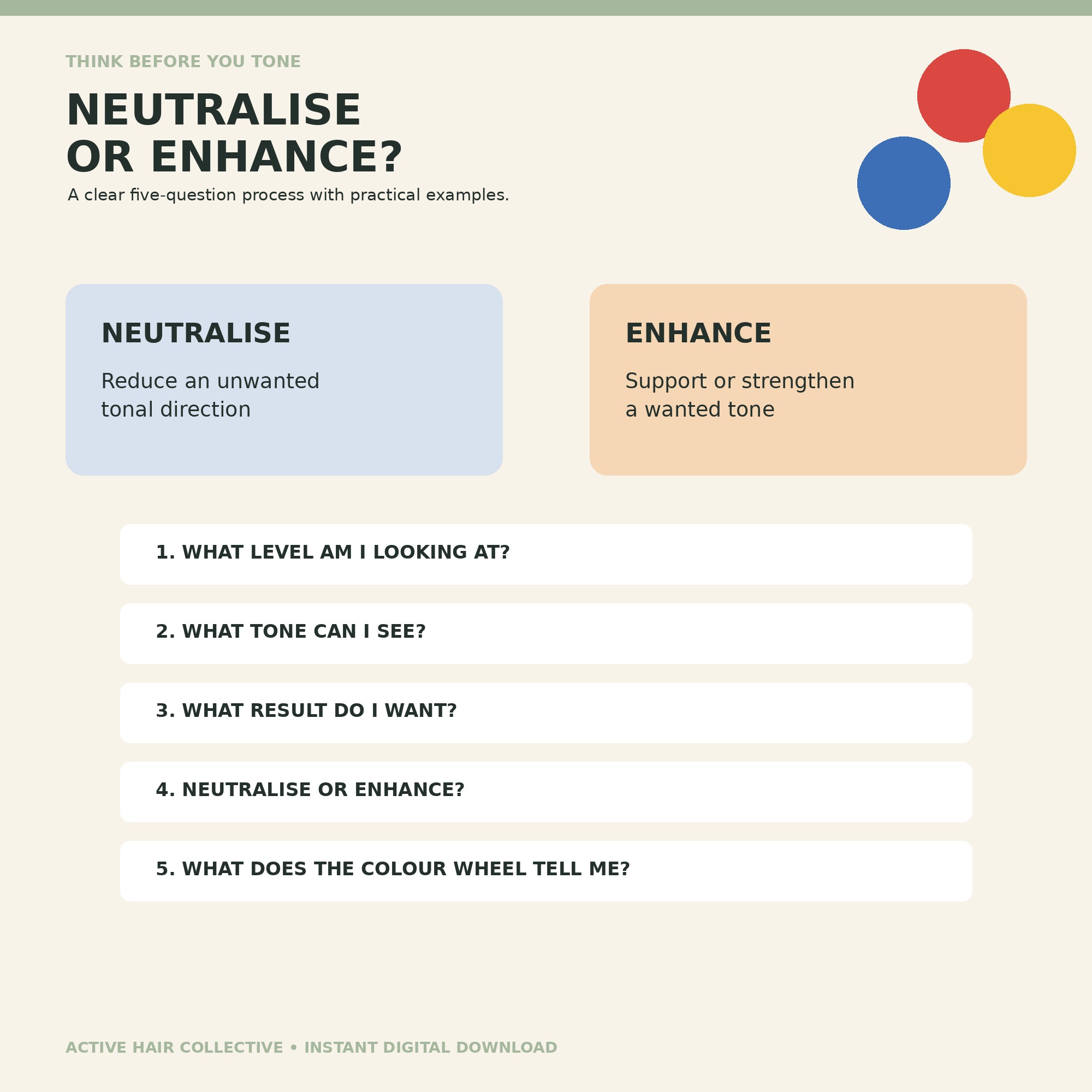
The colour wheel is one of the most useful visual tools in hairdressing. It helps you name the tone you can see, find the colour directly opposite it and make a more informed decision about neutralisation.
Why opposites matter
Colours opposite one another on the wheel counterbalance each other. In practical hair-colour theory, the three pairs to remember are yellow and violet, orange and blue, and red and green.
This does not mean every trace of warmth should be cancelled. It means the wheel gives you a direction when unwanted warmth is visible.
Yellow and violet
Yellow sits opposite violet. When pale yellow warmth is showing at a suitable light level, violet is the corresponding neutralising direction. The exact formula and strength must still be chosen according to the product range and the hair in front of you.
Orange and blue
Orange sits opposite blue. If orange warmth is visible, blue is the opposite colour on the wheel. Before reaching for a blue-based result, check whether the hair is at the correct level and whether the client wants a neutral, cool or warmer finish.
Red and green
Red sits opposite green. Green can help counterbalance unwanted red, but this pair requires the same careful diagnosis as any other correction. Consider the starting level, previous colour, porosity and the desired finish.
Neutralising is not the same as removing
Neutralisation is about visual balance. The aim is not always to remove every warm tone. Hair often needs warmth for a natural-looking or durable result, and excessive cool pigment can make the finish appear flat or muddy.
A simple routine
- Identify the visible tone.
- Assess the level and hair history.
- Clarify the target result.
- Find the opposite colour.
- Follow your chosen manufacturer’s guidance.
For a phone-friendly reminder, see The Pocket Colour Guide from Active Hair Collective. Its visual neutralisation pages and pocket cheat sheet are designed for students, apprentices and professionals who want the core rules close at hand.



Educational note: Always work within your training, complete the required tests and follow salon and manufacturer instructions.