
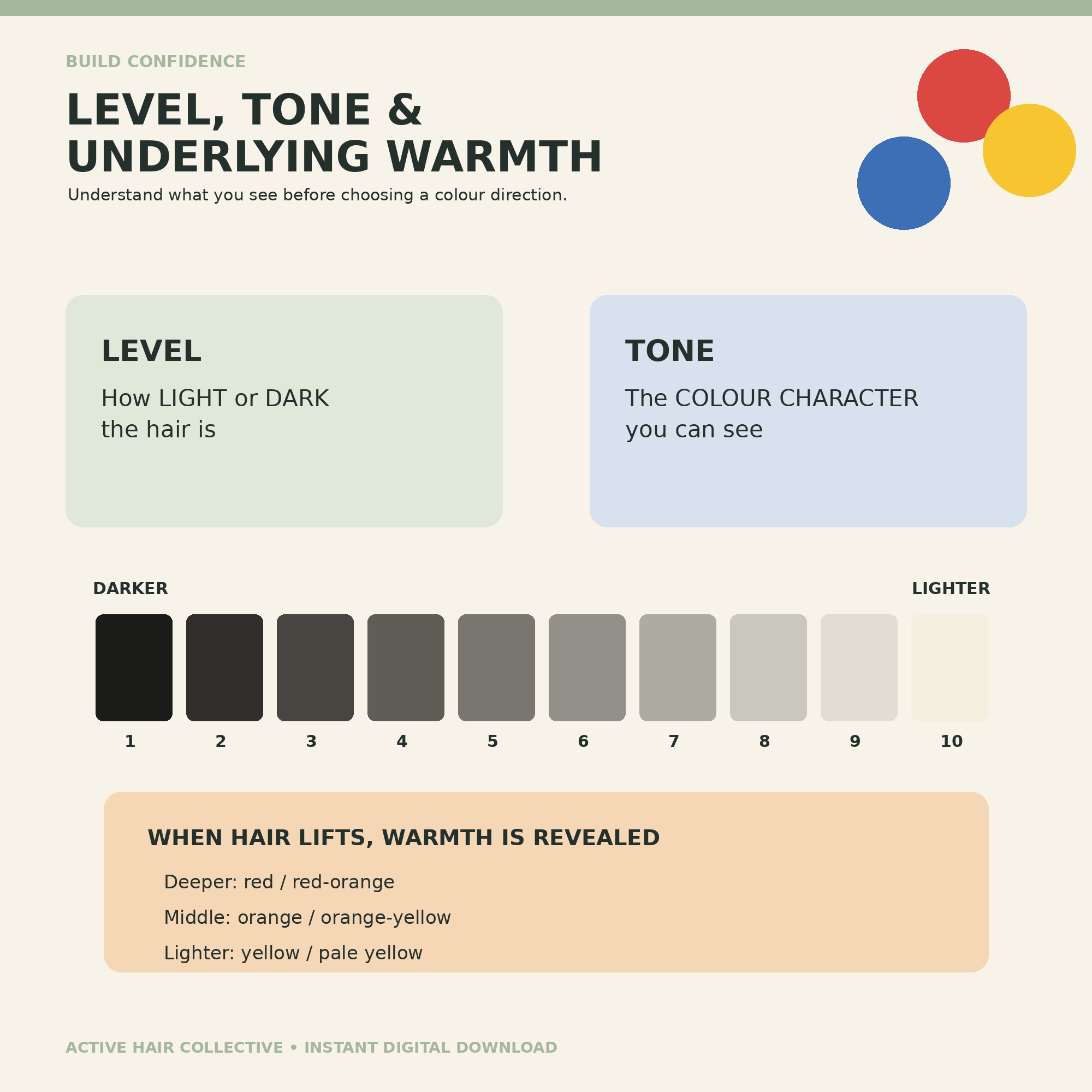
When unwanted warmth appears in the hair, the most useful first question is not “Which toner should I use?” It is “What colour can I actually see?” Accurate identification comes before product choice.
If you see yellow, think violet
Yellow and violet are opposites on the colour wheel. At lighter levels, a pale yellow background may call for a violet direction when the target is neutral or cool. Stronger yellow-orange warmth may need a different assessment, so avoid choosing from a label alone.
If you see orange, think blue
Orange and blue sit opposite one another. Blue is the neutralising direction for visible orange warmth, but the hair’s depth matters. A formula that works at one level may be unsuitable at another.
If you see red, think green
Red is opposite green. This relationship is useful when red is genuinely unwanted, but it must be approached carefully. Look at the full colour history and consider whether you are seeing red, red-orange or a mixture of tones.
Neutralise or enhance?
Warmth is not always a mistake. Copper, gold and red can be intentional, flattering and essential to the target shade. Neutralising means reducing an unwanted tone; enhancing means supporting a tone that belongs in the result.
Before choosing, ask:
- What level am I looking at?
- What tone can I see?
- What result does the client want?
- Does the tone need neutralising or enhancing?
- What does the colour manufacturer recommend?
Avoid the “ash fixes warmth” shortcut
“Ash” is too broad to be a complete diagnosis. Different brands use different tone systems, and the visible warmth may be yellow, orange, red or a combination. Identify the exposure colour first, then use the colour wheel and brand guidance to choose an appropriate direction.
The Active Hair Collective Pocket Colour Guide includes visual yellow-violet, orange-blue and red-green reminders, alongside a five-question decision process and simple examples.


Educational note: This is revision support, not a substitute for professional training, consultation, testing or manufacturer instructions.